For Birth Doulas
Virtual Doula Services: What to Offer, and How to Charge for It
Sivan Potash
Birth Doula & Childbirth Educator · Updated 28 September 2026
Virtual doula services are the same support a doula gives in the room, delivered by phone, video and messages instead: prenatal preparation, a steady voice through early labor, comfort ideas the partner can use, and someone who knows what is happening when the couple no longer does. In 2026 most doulas sell them in one of three shapes, at roughly a third to a half of an in-person fee, and the part that decides whether the service works is not the video call. It is whether you can see what is going on between the calls.
Over the past year I have talked with doulas in the United States, the United Kingdom and Australia who sell virtual support as a package. The ones who are happy with it all say the same thing: the service is only as good as what you can see between the calls.
What a virtual doula does, and what she does not
The work is the same work. You prepare her and her partner before labor. You answer the 2 a.m. “is this it?” message. You suggest the shower, the ball, the change of position, the snack. You read her voice between contractions and tell the partner what to do with his hands. You help her decide how she feels about the next step, and you stay with them until the baby is here or until you hand over to whoever is in the room.
What you do not do is examine, diagnose or decide when it is time to go in. That belongs to your client and her care provider, and the clearest virtual doulas say so in writing before labor. Virtual support is real support. It is not remote midwifery.
Three ways doulas package virtual services
Most virtual doula services on the market today fit one of these, and many doulas offer two of them.
1. Early labor add-on to an in-person package. You join her at home or at the hospital as you always have, but the hours before that are covered properly instead of by screenshots. This is the easiest one to sell because you are not changing what she buys, only how well the first part of it works. It is also where most of the value sits: early labor is long, and it is where couples feel most alone.
2. Standalone virtual package. Prenatal sessions by video, on-call support by phone and video through labor, and postpartum follow-ups, all remote. It suits clients in places with no doula, clients whose hospital limits who can be in the room, and clients who want your voice but cannot afford your presence. Some doulas run this as their whole practice and serve clients in several countries.
3. Backup clause in every contract. A line that says what happens when you are at another birth or cannot reach her in time: you support her remotely until your backup doula arrives, and here is how. This is not a product you advertise. It is what stops a missed birth from becoming a refund and a bad review.
Whichever you choose, describe it plainly in the agreement: which channels, which hours, what happens at another birth. Your client should know exactly what she is getting. The guide to offering virtual support in early labor goes through the prenatal conversation step by step.
What virtual doula services cost in 2026
Prices vary a lot by market, but the published ones cluster. A 2026 guide from Bornbir puts most virtual doula packages between $500 and $2,000, with hourly support around $100, against $800 to $3,500 per birth for in-person doula care in the United States. Two published price lists show the shape of the tiers:
Virtual birth support, 3 prenatal sessions, 1 postpartum · $497
Labor support: phone or video on call
Premium, 5 prenatal sessions, 3 postpartum · $997
Labor support: on call, priority response
Birth support, pregnancy support and planning · $1,195
Labor support: phone, email, video, 24/7 in active labor
| Provider (US, published Sept 2026) | Package | Price | Labor support |
|---|---|---|---|
| VirtualBirthCo | Birth prep coaching, 2 prenatal sessions | $297 | none |
| Virtual birth support, 3 prenatal sessions, 1 postpartum | $497 | phone or video on call | |
| Premium, 5 prenatal sessions, 3 postpartum | $997 | on call, priority response | |
| The Womb Room | Birth planning | $195 | none |
| Pregnancy support and birth planning | $495 | none | |
| Birth support, pregnancy support and planning | $1,195 | phone, email, video, 24/7 in active labor |
Three things to take from the table. The labor-support tier is where the price jumps, so that is the part to describe most carefully. Prenatal-only packages sell at $200 to $300 and are a low-risk way to start. And nobody on these lists is charging for what most doulas actually spend the night doing, which is chasing updates. If your virtual service lets her rest and lets you see the pattern, say so; it is a reason to be at the top of that range rather than the bottom.
When a doula asks me what to charge, I tell her to price the night, not the call. The night is what the couple remembers.
What goes in the agreement
Remote support falls apart when the plan is made in the middle of a contraction. Settle it at a prenatal meeting and write it down: the channels you use, when she reaches out, when she calls her provider, what her partner does, your on-call hours and your backup, and a practice run with the tools she will use on the day. Each of these is covered in the guide to offering virtual support in early labor. What belongs in a paid package specifically is the last two: the hours you promise, and who takes over if you are at another birth.
Following labor from a distance without living on the phone
Between calls, the question is always the same: is the pattern building, or did it settle again? A message tells you one moment. What you are selling is knowing the direction.
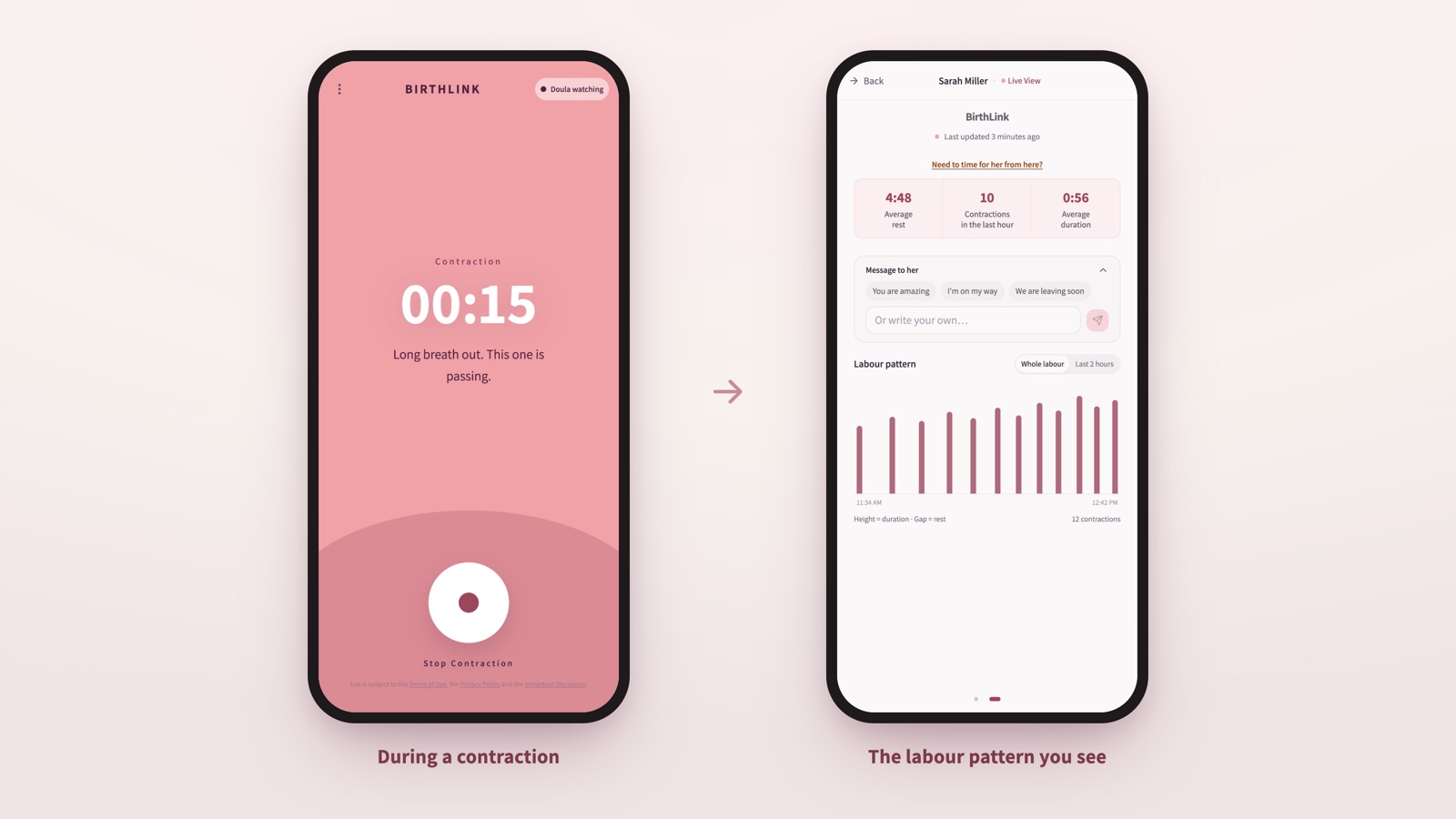
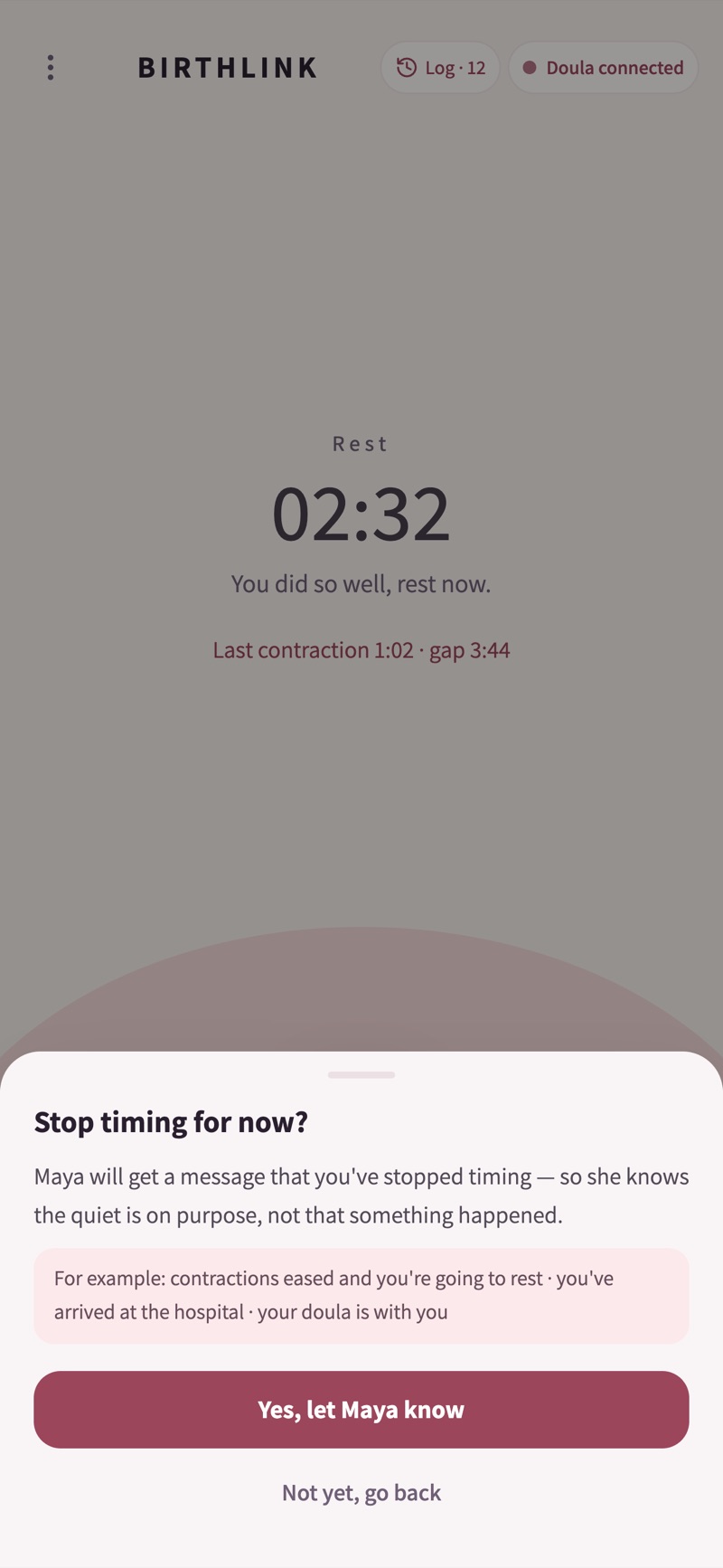
This is the part I built BirthLink for. Your client times contractions from a link in her phone’s browser, with nothing to install, and you follow the same contractions live on your own phone: duration, rest, the pattern over time. You can send her a short line from your screen, and if she is too far in to tap, you can time for her from your side. It sits alongside your calls and messages. It does not replace talking to her. More on how it works: a contraction timer for doulas.
It also changes the rhythm of the night. She can put the phone down between contractions, and you reach out when something changes, not on a schedule.
Who buys virtual doula services
- Families with no doula nearby. Rural areas, small countries, expats.
- Hospitals that limit support people. One companion in the room means the partner goes in and the doula is on the phone.
- Second-time parents who want a voice for early labor and know they will not want a stranger in the room this time.
- Budget-conscious clients who could not afford an in-person package but can afford yours at half the price.
- Your own in-person clients, in the hours before you arrive. This is the group most doulas forget to count.
How to say it on your website
Doulas often bury virtual support in a paragraph about “flexible options.” Say it in its own section, in plain words, with a price. A working template:
Virtual doula support. I support families by phone, video and messages when I cannot be in the room, and in early labor before I join you. You get [number] prenatal sessions by video, on-call support by phone and video from [week] until your baby is born, and [number] postpartum check-ins. During labor you time your contractions from your phone and I follow them live from mine, so you can rest between them and I can call when something changes. [Price]. This is doula support, not medical care; decisions about when to go in stay with you and your provider.
Frequently asked questions
What are virtual doula services?
Emotional, informational and practical support from a doula delivered by phone, video and messages instead of in person: prenatal preparation, on-call support through labor, and postpartum follow-up.
How much do virtual doula services cost?
Published US packages in 2026 range from about $200 for prenatal-only coaching to $1,000 to $2,000 for full virtual labor support. In-person birth doula care runs $800 to $3,500. Prices vary by region.
Can a virtual doula support a whole labor?
Yes. Some doulas offer virtual support for the entire labor; others support early labor remotely and join in person later. What matters is agreeing the plan in advance.
How does a virtual doula know what is happening during labor?
Through the client and her partner, by voice and video, and through a shared contraction timer. With BirthLink the client times contractions on her phone and the doula sees the pattern live on hers, without screenshots.
Is virtual doula support medical care?
No. A virtual doula does not examine, diagnose or decide when it is time to go to the hospital. Those decisions stay with the client and her care provider.
Do I need special software to offer virtual doula services?
A phone and a video app are enough to start. A shared contraction timer makes early labor much easier to follow; BirthLink's first five clients are free, so you can try it on your next client before deciding.
BirthLink was made by a practicing birth doula. Questions about offering virtual support? Write to me at sivan@birthlink.app.
Try it with your next clientQuestions? Write to sivan@birthlink.app

